
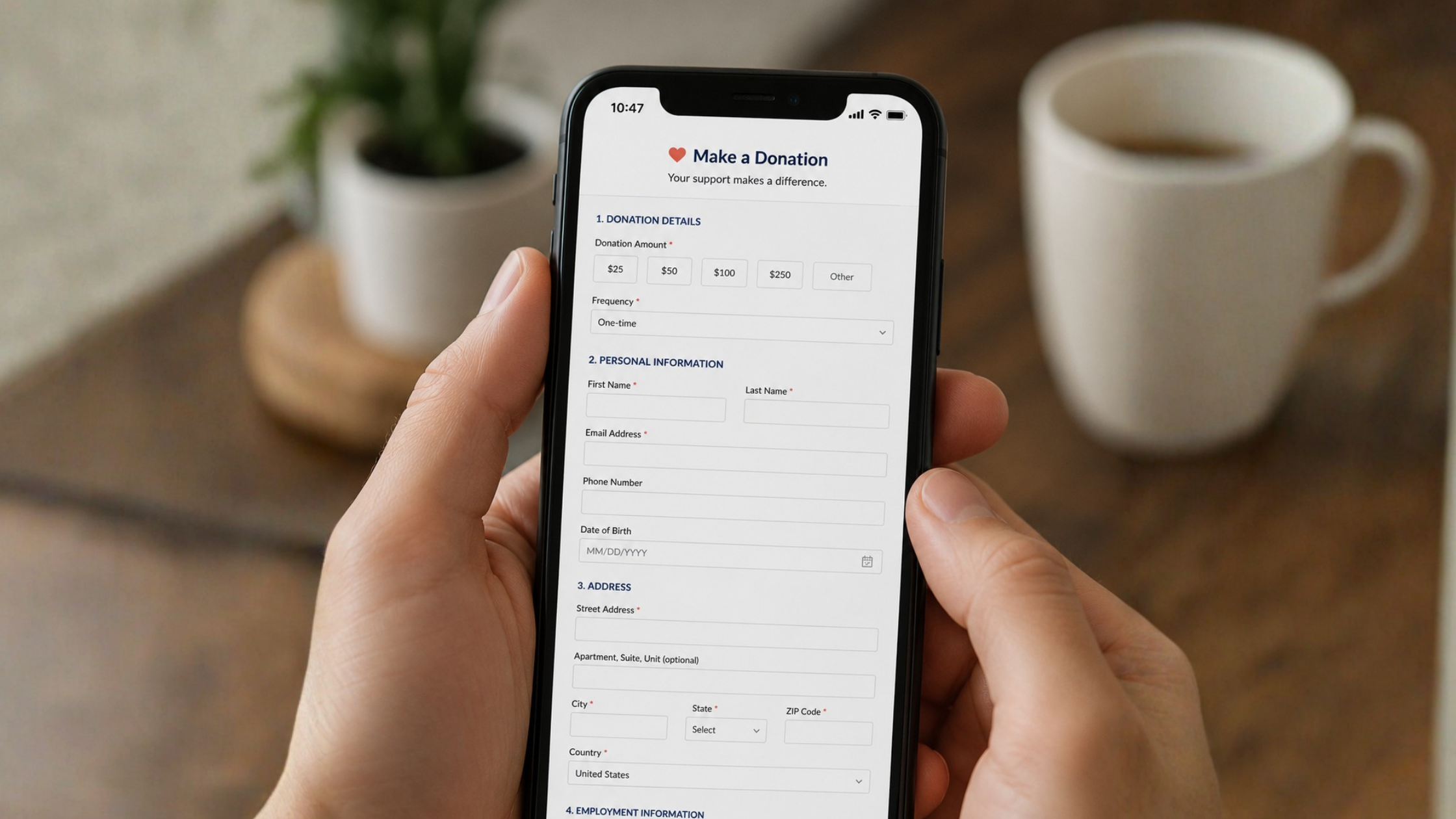
What information do you ask donors to provide before they can make a donation?
- First and last name
- Email address
- Birthday
- Mailing address
- Phone number
- How they heard about you
If your answer is just the first two, you’re safe.
If you’re requiring more than that before accepting the donation, you may be killing your donor conversion.
The problem isn’t the data. It’s the timing.
Every additional field creates friction.
You might think it’s “nice to have” more donor information upfront, but every extra question increases the chance that someone abandons their donation before completing it.
Good intentions. Terrible consequences.
Instead of this:
Collect all donor data → Accept donation
Do this:
Collect essential data → Accept donation → Collect extra data
We call this the two-step system:
Secure the gift first, then collect the extra donor data after.
It creates a smoother experience, reduces friction, and helps more donors complete their gift.
Why donors abandon long forms
The psychology is surprisingly simple.
Too much effort. Every required field increases the mental effort needed to complete the donation.
Interrupted motivation. Donations are emotional decisions. Long forms interrupt that momentum and give donors time to reconsider or simply get distracted.
Privacy concerns. Asking for unnecessary information makes donors wonder why it’s needed and how it will be used.
More friction = fewer donations. Time, effort, and uncertainty all become part of the perceived “cost” of giving, especially if they are using mobile devices.
A real-world example
We’ve seen this happen with one of our clients.
They had turned on and asked for every available field prior to completing the donation.
It probably looked like this. A few donor records came through incomplete from our default setup. Someone in development or accounting asked, “Where’s the missing information?” Someone else said, “Why don’t we just require it upfront?” And everyone felt good because the process looked cleaner on the inside.
Unfortunately, donors do not care about your internal process.
They are not sitting on their phone thinking, “At last, a chance to improve this nonprofit’s CRM hygiene”. They are ready to give, they click donate, and suddenly they are being asked to complete administrative chores for a gift they have not even made yet.
Collect what matters first
Once the payment is complete, you already have the essentials:
- the donation
- the donor’s name
- their email address
If they complete the extra fields, great. If they don’t, FundRazr automatically follows up with a reason that actually matters to them. For example:
“Please complete your information so we can issue your tax receipt.”
That’s a much stronger incentive than asking for everything upfront.
Many donors will complete the missing details because the request is tied to something they value.
And if they don’t? That’s okay.
You still have the contribution, the donor’s name, and their email address – enough to continue building the relationship over time.
Don’t let perfect data cost you real donations
If your organization insists on collecting a perfect donor record before accepting a donation, there’s a good chance you’ll lose donations that would otherwise have been completed.
The better approach is simple:
Payment first. Data second. Always.