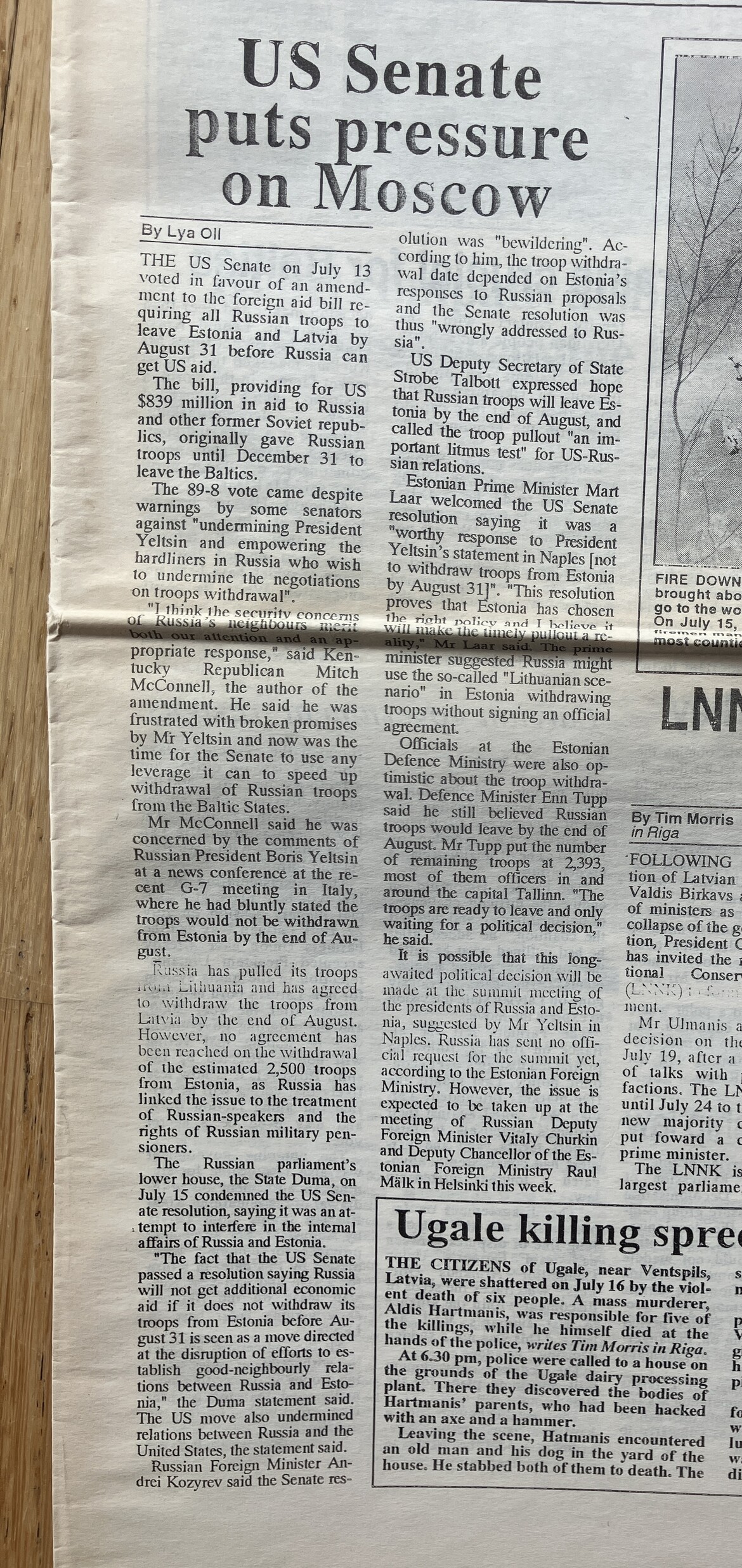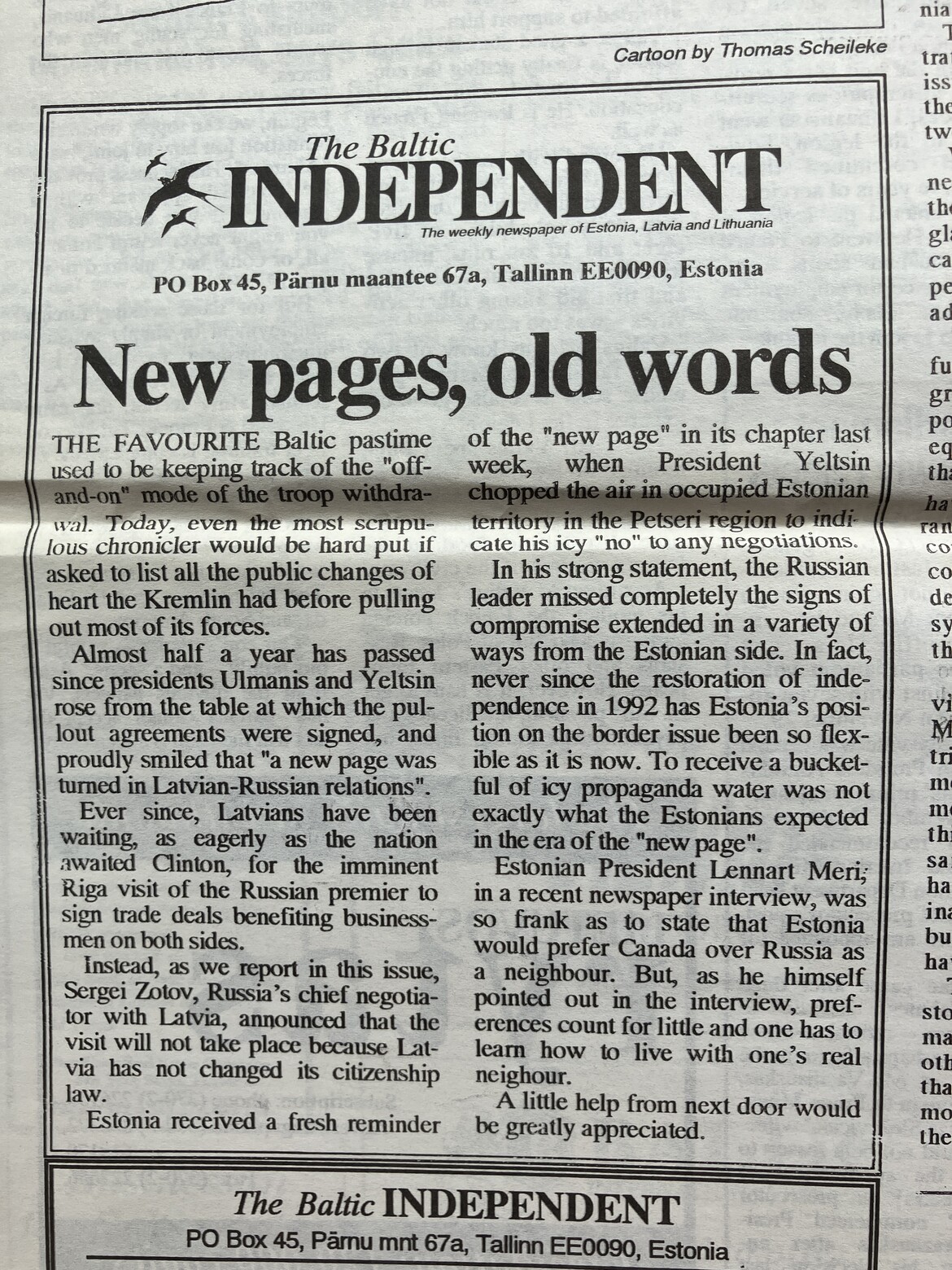

The years 1991-1995 were the critical years, in which the three Baltic countries of Estonia, Latvia, and Lithuania implemented renewed democratic processes for their sovereign countries, after losing their independence for ~50 years under a USSR Occupation.
 An English
weekly newspaper called The Baltic Independent was
published from the three Baltic countries for the years from 1990-1996.
An English
weekly newspaper called The Baltic Independent was
published from the three Baltic countries for the years from 1990-1996.
Of the full collection, I have about 4/5, from June 1991 to December 1995, which were sent to my mailbox in the San Francisco Bay Area. After 1995, I put these newsletters in a box and barely looked at them until 2022. The box stayed with me through four international moves to finally reside in my home in Rīga, Latvia.
 Despite
their box storage, the last 30 years have taken their
toll, and now these newsletters are beginning to show their
age. Some are slightly yellow, some have dry edges.
Despite
their box storage, the last 30 years have taken their
toll, and now these newsletters are beginning to show their
age. Some are slightly yellow, some have dry edges.
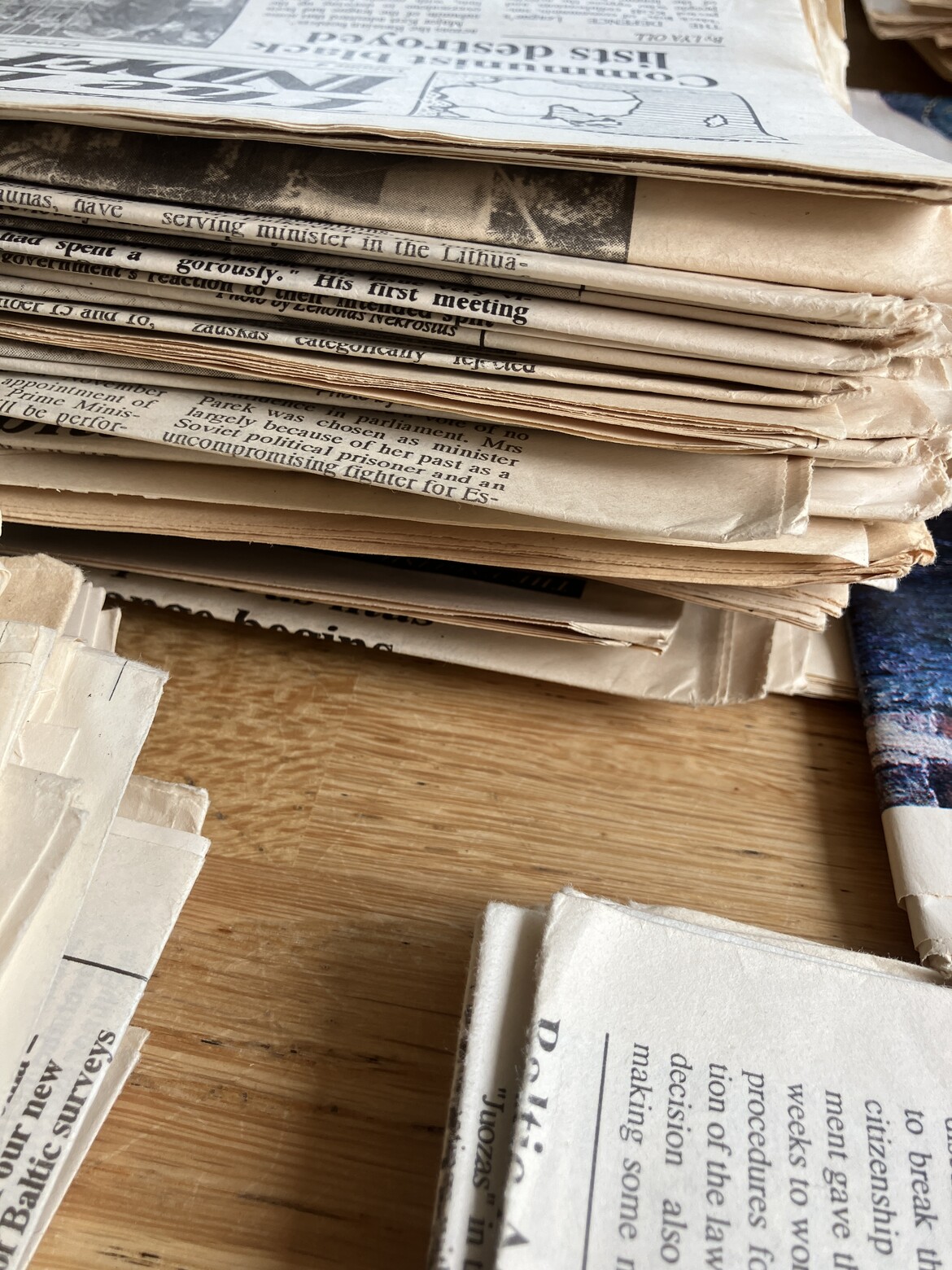
They should be digitized before the paper becomes brittle.
After considerable searching, I have not found another digital archive of The Baltic Independent. My collection, which I've shown ~20 pages, using phone snapshots since 2022 on social media, appears to be the newsletters' first digital appearance.
Currently, The Baltic Independent archives exist in these other places:
- Latvian National Library 'Reading Room' (paper copies)
- Estonia Networked Libraries on-site reading (paper copies)
- Lithuania Networked Libraries on-site reading (paper copies)
- Stanford Reading Room (paper copies)
Other online places I've checked where the newsletters should be, they don't appear to exist:
- US Library of Congress (doesn't have)
- Lithuania digital archive (doesn't have)
- Illinois Digital Baltic archive (doesn't have)
The digital curators at the Latvian and Estonian libraries don't have current plans to digitize their paper copies, but they told me they might consider it in the future.
IMO 'future' is too much of an unknown for these libraries, while we have the geopolitical, intense Summer 2024, digital information space of today. Russian Disinformation is rampant.
This is a Perfect Window of Time to scan these newsletters.
In this Summer 2024, I have a window of opportunity where my teen daughter (top photo) is available for the next six weeks to complete 3/4 of this Baltic Independent Scanning task for me and with reduced time in September and October after her school starts. We are a family of two. I am a scientific researcher with a new, still not yet fully sustainable business where my time is needed for building my new business. She is ready to do the scanning work now.
Campaign Main Points
- Human help to perform the repetitive task (200 of the 320 hrs) is available now. Goal to complete the 220 newsletters by end of October.
- Newsletters' paper is dry but not yet brittle. Must be scanned soon.
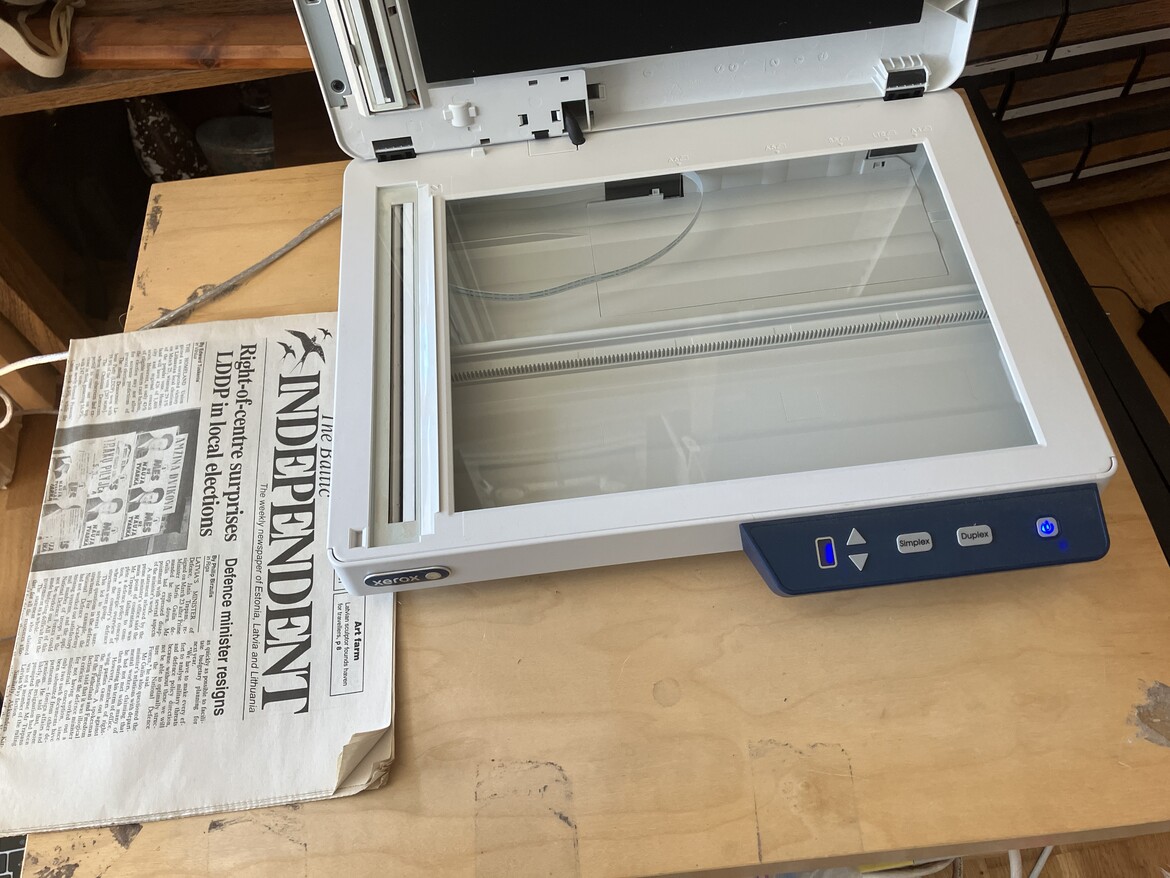
- Xerox Flatbed scanner suitable for Newsletter is available (and barely used).
- Digitization software (Xerox Visioneer) works perfectly.
- OCR software (ABBYY FineReader) tested and works perfectly.
- How to scan, OCR, and store these newspaper pages is well-scoped. More details below.
- I'm only missing financial resources to pay my teen's 320 hrs of time.
What can the world learn from these Baltic Independent newsletters?
Muscovy-USSR-Russia has a Formula for Occupation, re-used over the last 100+ years. 1) Chip away at a sovereign country's borders. 2) Implant pro-Russian actors inside your territory to act against your country (5th column). 3) Change your country's laws to favor the Kremlin.
Despite the three Baltic countries' newly won Re-Independence, Russia's aggressive actions were on full display in the five years of news pages of The Baltic Independent.
Russia did NOT change after 1991.
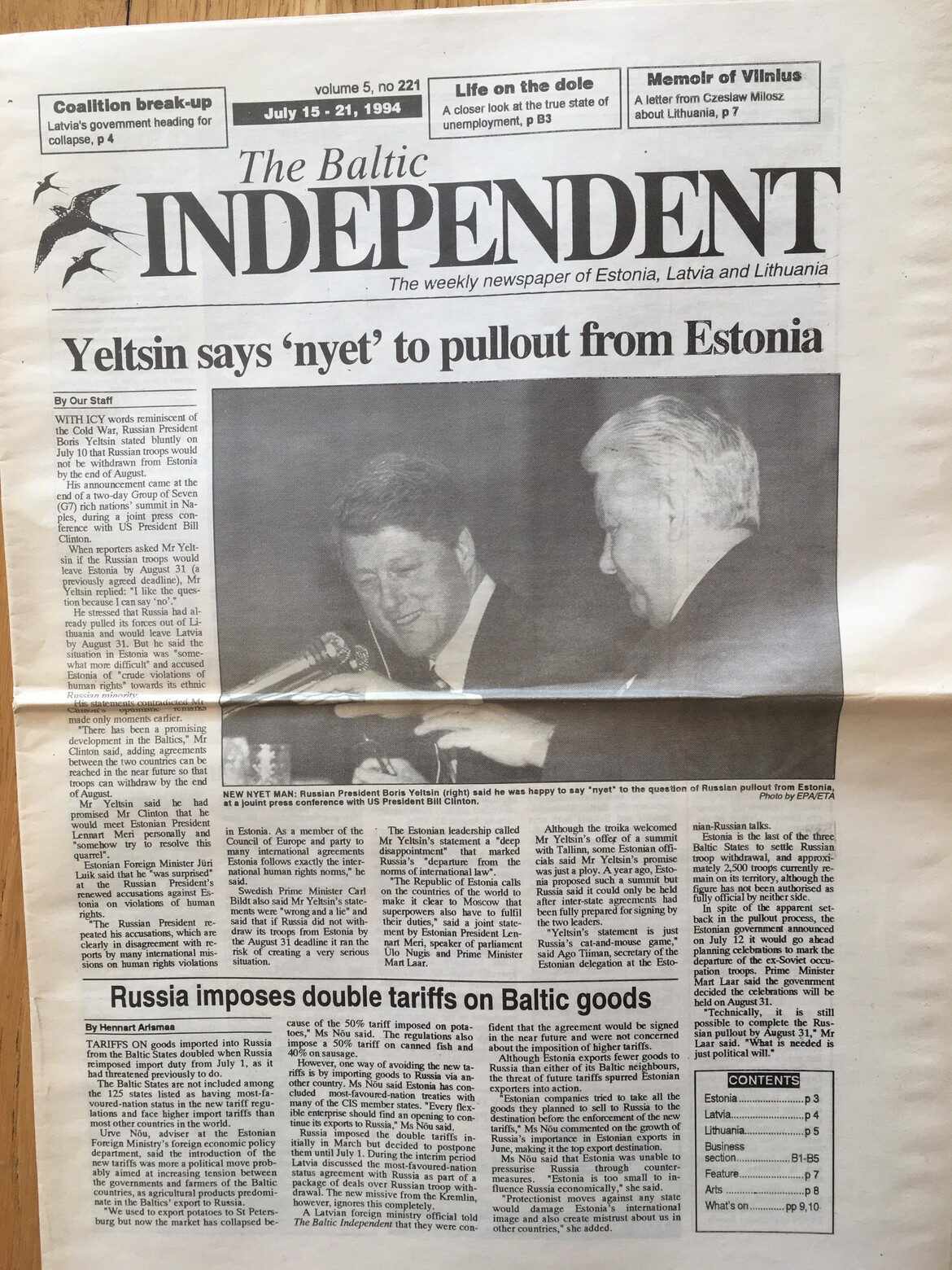
The former Soviet-Russian Occupied territories through the last century have an unusual and unique set of challenges to [re]build their democracies post Occupation, especially if de-colonization does not take place and Russia continues to act aggressively.
After 1991, it was a massive challenge with Lessons Learned, after one generation, for what went right and what went wrong in the Baltic countries.
As seen in The Baltic Independent newsletters, Step by Step, the Baltic countries succeeded.
How did the Baltic countries:
- remove 100s of 1000s of Red Army soldiers?
- build new political parties and democratic governments while excluding KGB agents?
- eject, if possible, all Russian intelligence operatives?
- remove key USSR military facilities from their countries?
- maintain their sovereign and constitutional borders?
- nurture and promote their own ancient cultures amidst loud, demanding Russian actions and voices?
- recover all real estate properties, with opportunities for partial ownership for pre-1940 citizens:
- privaticize all state property?
- *democratically* incorporate former Soviet occupiers with residencies and citizenships, while simultaneously being nearly a minority in their own countries (Latvia) ?
- form economic partnerships with non-Russian entities?
The three Baltic countries had considerable help, confusing help, mistakes and misunderstandings on the international stage, which is documented in these newsletters too.
DETAILS for How we (mostly teen daugther 15 1/2 yrs) will scan, OCR, and store these newspaper pages.
Newsletter Collection
I have 219 weekly Baltic Independent newsletters.
Some years are not complete. 1992 and 1993 are complete.
1991:
15
1992: 52
1993: 52
1994: 50
1995: 47
-----------
216 weekly newsletters, from 6pgs to 16pgs each.
+ 3 Baltic Outlook Year End special issue = 219 newsletters to scan.
Different number of pages, increasing every year.
1991: 6 pages
to 1995: 16 pages.
Some yellowing, especially edges. Beginning to
show fragility.
Each Newsletter: 40cm x 30cm
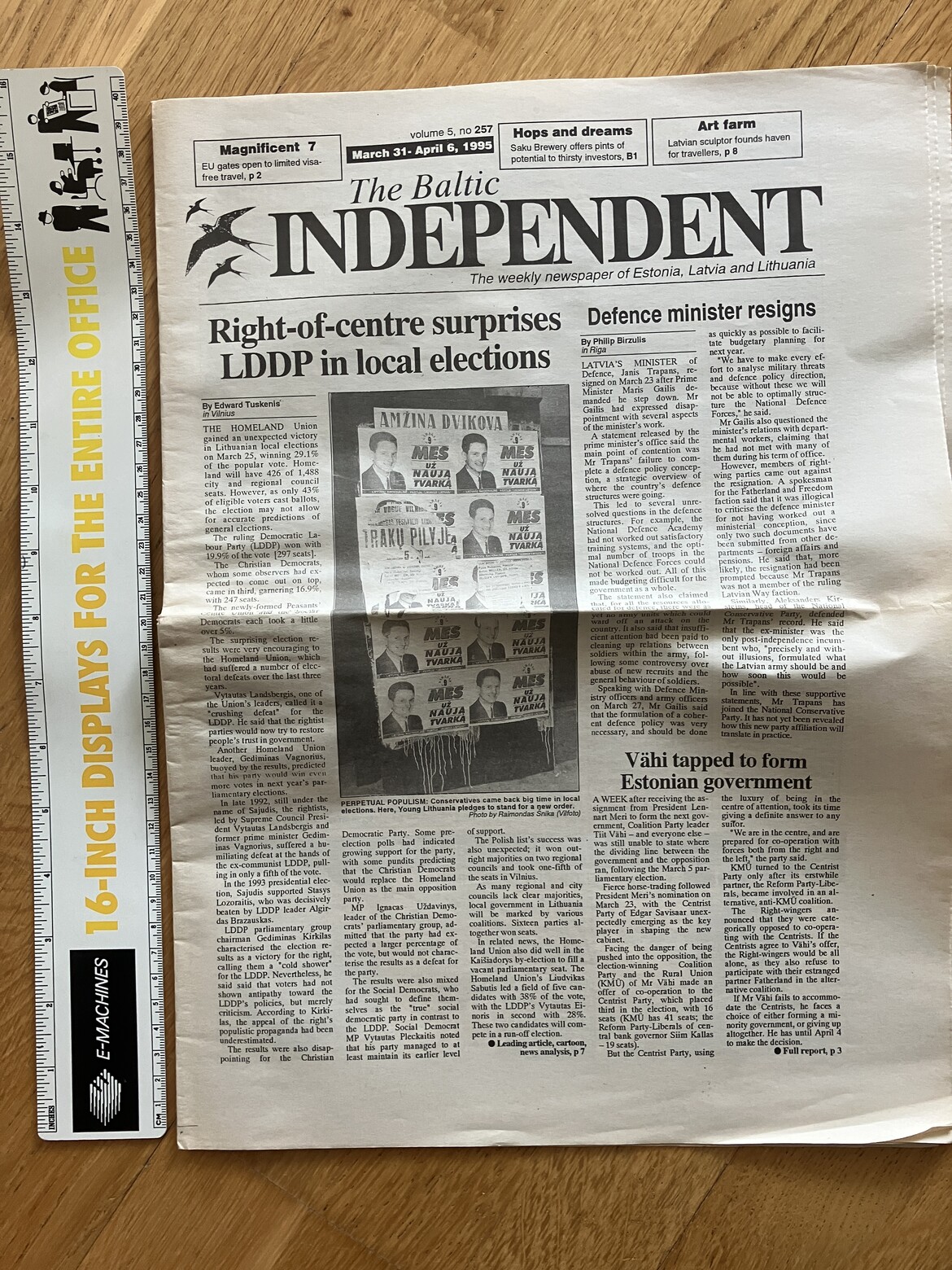
I have a Xerox Duplex scanner. We will scan on one side only.
HALF Page Scans per newsletter page: TOP half. BOTTOM half.
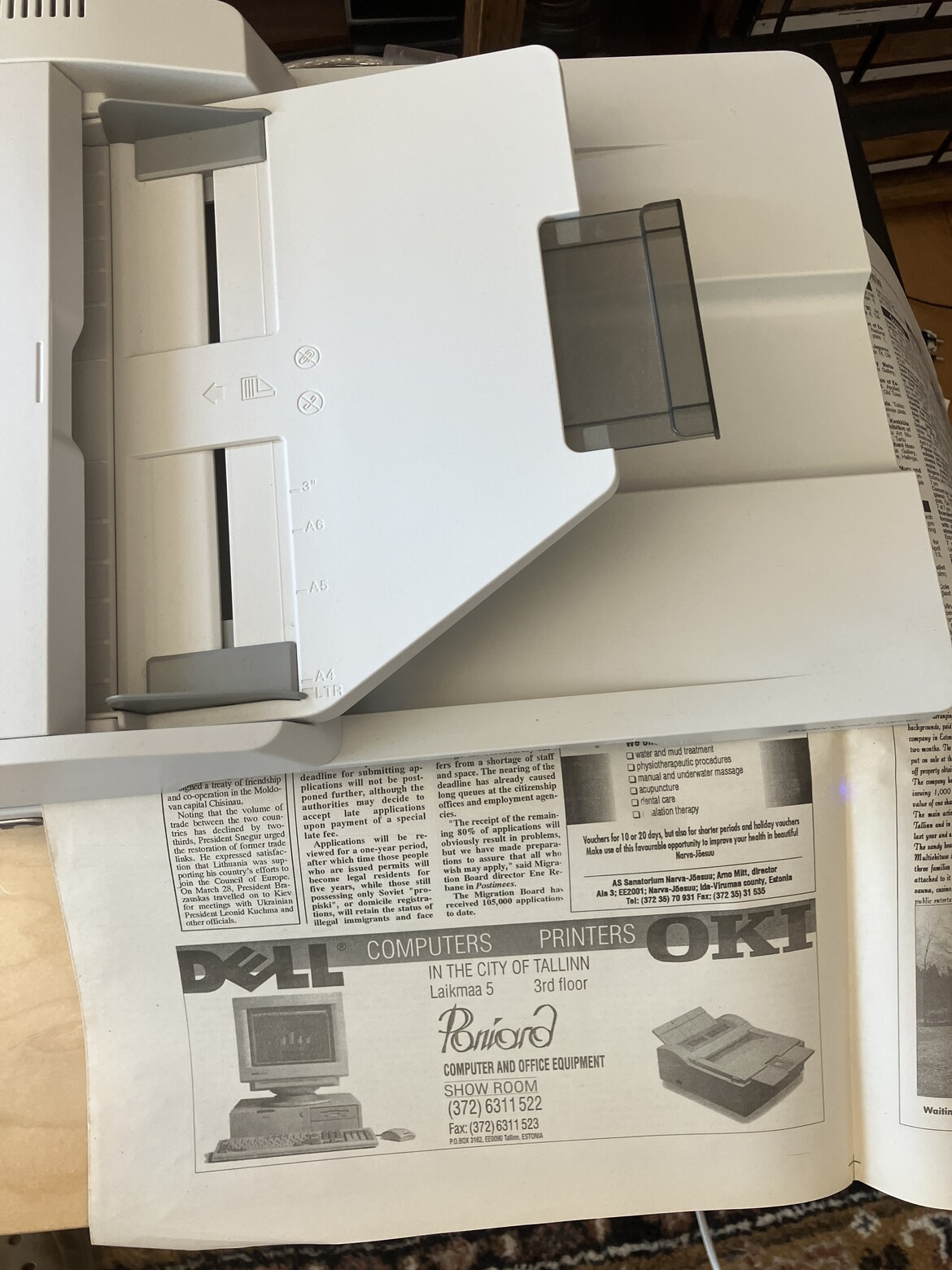
We will run two applications for EACH Half-Page.
1) for bitmap (TIF output): Xerox Visioneer
2) for OCR (MS Word output): ABBYY FineReader
This strategy will therefore support:
1) Bitmaps for every newsletter 1/2 page for future post-processing.
Xerox Visioneer Scan software at 600dpi grayscale TIF output (bitmap format)
Output- 300-500 kB per TIF file (1/2 page of Baltic Independent).
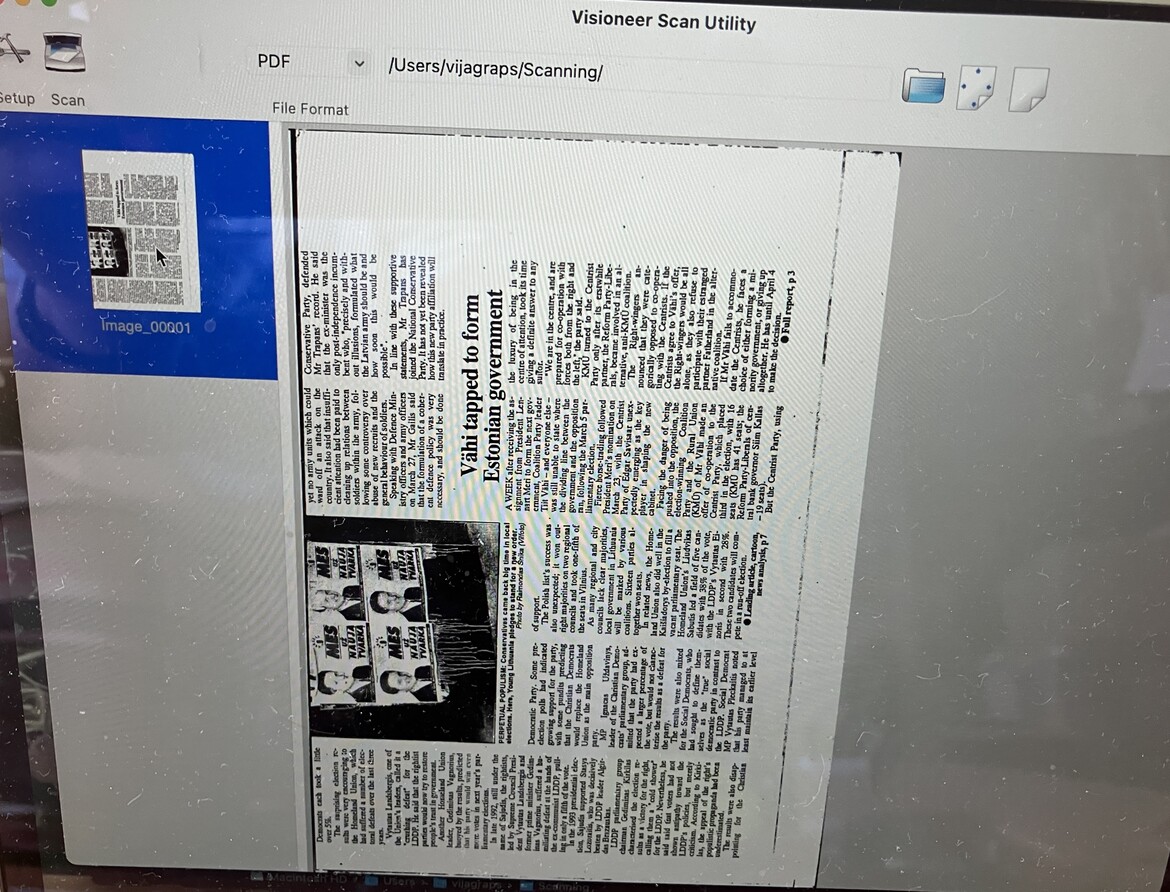
These Bitmaps support Future Post-processing by someone (not part of this campaign unless there is more funding and it is requested) for a proper newspaper archive.
Postprocessing might be to stitch the two bitmap halves together and THEN OCR recognize columns as per this Library of Congress scanning strategy.
2) OCR. Run ABBYY FineReader. Output to MS Word format.
To support The Baltic Independent newsletter Search through computer directories using text to a half-page of newsletter.
 Output:
MS Word format.
Output:
MS Word format.
 It's
not perfect; FineReader tried to OCR the newsletter's flying birds
logo. However for OCR, that does not matter. The text searches work
perfectly to locate text on the 1/2 page.
It's
not perfect; FineReader tried to OCR the newsletter's flying birds
logo. However for OCR, that does not matter. The text searches work
perfectly to locate text on the 1/2 page.
Additionally, the MS Word format allows post-processing cleanup if that is desired and funded.
Output: MS Word OCR file: 1.0-1.5Mb per 1/2 Baltic Independent page.
Estimated Scanning Time?
Early Baltic Independent newsletters: 6 pages.
Later Baltic Independent newsletters: 16 pages.
Average = 11 pages
Each 1/2 page scan by each application: ~1-2 minutes = maximum of 4min for the 2 applications.
4min per 1/2 page x2 half-pages x 11pages (average) per newsletter.
= 88 min x 219 newsletters = ~20,000 minutes
Estimated scan time: ~320 hours
Lining up the pages on the scanner and organizing the file names per newsletter directory should become more automatic with practice. It is a manual, labor-intensive work.
Estimated Storage Space?
OCR pages:
~1.2Mb/1/2 page x 2 x 11 x 219 newsletters = 5800Mb = ~6Gb
for total OCR'd half-pages in MS Word format
Bitmap pages:
~500 kB /1/2 page x2 x11 x219 newsletters = 2.41 x10^6 kB = ~2.5Gb
for total Bitmapped half-pages in TIF format
Sum of Bitmap + OCR 219 newsletters = 8.5 Gb Storage needed.
Google drives give 15Gb storage. We will use that for now until long-term storage from the community is secured.
What will you get?
Weekly stories plus my own suggested Keywords for your own Searches through the Google drive directory.
Possible stories that will Emerge from these Newsletters:
1) What are the Clues seen in 1991-1995 at higher education that explains how EE transitioned away from 'Academy of Science' model?
2) Privatization of State Assets. What % of sold enterprises were in the hands of local (EE/LV/LT) persons?
3) New businesses. What % of new businesses were started by local (EE/LV/LT) people?
4) When did the large shipyards (e.g. Riga., Ventspils) get into the hands of the oligarchs. How?
5) What were some of the methods which Russia used to impede EE/LV/LT's entry into NATO? Newsletters revealed the Partnership for Peace program. What else?
6) Citizenships. What allowed Russian parties to participate in LV government: the parliament?
7) How many government officials resigned after discovery of their KGB ties?
8) When did private property split to allow virtual land to be sold to pre-1940 families of residents?
9) Why does LV have so many political parties? Are there clues in these years?
10) How did LT manage its own Red Army withdrawal in 1993 and when did it decide a Referendum was the answer?
11) What ways did EE/LV/LT use to try to convince the West that Kaliningrad needed to be de-militiarized?
12) What policy did LT put in place to allow transit (military too) to Kaliningrad?
13) What discussions took place to allow Soviet Occupants to have dual citizenships?
14) What were the most common sabotage actions by Russia during this time?
15) How was Russia changing Estonia's (and Latvia's?) border and when did Russia's unilateral demarcation stop?
16) How many Red Army military officers ultimately stayed in the Baltic countries (i.e. so-called 'pensioners') ?
17) How many international organizations did Russia use to claim that human rights violations (propaganda) was high ('ethnic cleansing' they called it) in the Baltic countries?
18) What methods did Russia use to slow down the Baltic countries EU membership?
19) How did the oligarchs get Latvia's largest industries?
20) What were the main differences between LV, EE, LT for allowing Soviet-Russian occupants to participate in LV, EE, LT governments?
21) How did EE, LV, LT build economic partnerships with non-Russian businesses?
More Examples of what is inside these newsletters:
Collected from my reading of a portion of the newsletters. These are simple phone camera snapshots!